Fundamentals of communication:
The importance of communication in human society has been recognized for thousands of years, far longer than we can demonstrate through recorded history. As humans, we have the communication abilities that other animals do not.
Meaning of communication
The term communication is derived from the Latin word “Communis”which means to share. Effective communication is when the message conveyed by the sender is understood by the receiver in exactly the same way as it was intended.
Communication is a Basic need of life it helps us in Sharing each others feelings and needs.
We have come a Long way from cave dwelling man and Yet to be social generation man. We are among the most highly social beings as we are in the era of Instant messaging.
Definition:
The Communication is a two-way process wherein the message in the form of ideas, thoughts, feelings, opinions is transmitted between two or more persons with the intent of creating a shared understanding.
Communication as a process:
The process of communication refers to the transmission or passage of information or message from the sender through a selected channel to the receiver overcoming barriers that affect its pace.
Communication process consists of certain steps where each step constitutes the essential of an effective communication.
The communication is a dynamic process that begins with the conceptualizing of ideas by the sender who then transmits the message through a channel to the receiver, who in turn gives the feedback in the form of some message or signal within the given time frame. Thus, there are Seven major elements of communication process:
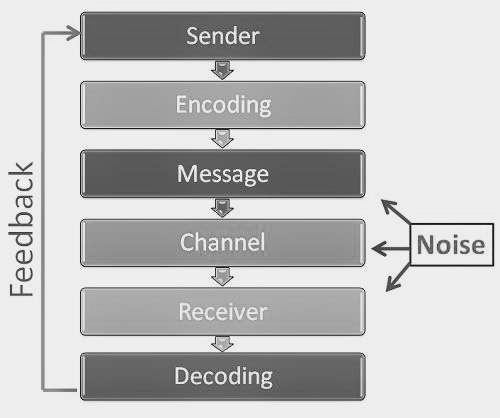
1. Sender: The sender or the communicator is the person who initiates the conversation and has conceptualized the idea that he intends to convey it to others.
2. Encoding: The sender begins with the encoding process wherein he uses certain words or non-verbal methods such as symbols, signs, body gestures, etc. to translate the information into a message. The sender’s knowledge, skills, perception, background, competencies, etc. has a great impact on the success of the message.
3. Message: Once the encoding is finished, the sender gets the message that he intends to convey. The message can be written, oral, symbolic or non-verbal such as body gestures, silence, sighs, sounds, etc. or any other signal that triggers the response of a receiver.
4. Communication Channel: The Sender chooses the medium through which he wants to convey his message to the recipient. It must be selected carefully in order to make the message effective and correctly interpreted by the recipient. The choice of medium depends on the interpersonal relationships between the sender and the receiver and also on the urgency of the message being sent. Oral, virtual, written, sound, gesture, etc. are some of the commonly used communication mediums.
5. Receiver: The receiver is the person for whom the message is intended or targeted. He tries to comprehend it in the best possible manner such that the communication objective is attained. The degree to which the receiver decodes the message depends on his knowledge of the subject matter, experience, trust and relationship with the sender.
6. Decoding: Here, the receiver interprets the sender’s message and tries to understand it in the best possible manner. An effective communication occurs only if the receiver understands the message in exactly the same way as it was intended by the sender.
7. Feedback: The Feedback is the final step of the process that ensures the receiver has received the message and interpreted it correctly as it was intended by the sender. It increases the effectiveness of the communication as it permits the sender to know the efficacy of his message. The response of the receiver can be verbal or non-verbal.
Note: The Noise shows the barriers in communications. There are chances when the message sent by the sender is not received by the recipient.
Types of Communication
Communication is carried out formally or informally and can be verbal or non-verbal.
1. Formal Communication
Formal Communication is done in a professional manner. This type of communication is mostly used in an office setting, during cooperate meetings and conferences. Proper titles of those you’re addressing is a must here.
2. Informal Communication
Informal Communication is the opposite of formal communication. Here people are less adherent to protocol and can engage in a casual manner. Authority lines are not followed and people can use slang, refer to each other without using job titles, etc. Due to the casual manner, people engage it is good for building relationships.
3. Verbal Communication
When passing information verbally you pass it by word of mouth or in writing. Communication experts say when using verbal communication Keep It Short and Simple(KISS).
4. Non-Verbal Communication
This means that the person communicating with you is using body language, posture, facial expressions, gestures, etc. For example, the tone of voice is a non-verbal clue indicating whether an individual is angry or not. Always watch the body language of a speaker it will communicate a lot.
Barriers of communication:
Barriers to communication are things that get in the way of a message being received. They could be physical, such as loud music playing, or emotional, such as when a person is too angry or fearful to listen to what another individual is saying. Culture, language, and social status can also represent barriers to effective communication. Managers need to be aware of barriers and how to overcome them to improve the communication process.
Every time we talk or listen, there are things that get in the way of clear communication—things that interfere with the receiver getting the message from the sender. This interference is referred to as “noise,” and there are various types of noise that can cause a message to be misinterpreted.
1. Language Barrier
The language used by the sender may not be understood by the receiver. Also, the two-people communicating may speak the same language but the jargon used to pass the information may breakdown communication if the receiver doesn’t fully understand it. For example, if an expert uses industry terminology while communicating to an intern he/she will not be understood because they are yet to learn the terminology.
2. Emotional Barriers
The state of mind of the communicators can hinder the delivery of information. If the receiver is having issues they are likely to be less attentive, which could lead to poor communication. The mental state of the sender and receiver influences how the message is received, perceived, and sent.
3. Physical Barriers
The environment one is in determines how good communication is. If a receiver of a message is in a noisy place he is unlikely to hear what message is being conveyed. Vice versa if an encoder at a musical concert he cannot pass information clearly. Geographical distance also is a barrier to communication.
Generally, communication is faster over a short distance as many communication channels are available and less technology is required. If you are to send a message to a person in Antarctica this may prove difficult as mobile communication is unavailable or poor. Face to face communication is best as both are in the same place.
4. Systematic Barriers
In an organization, communication may be barred because they are no channels to communicate amongst themselves. For example, a junior employee may not be able to access the company CEO because no measures have been put in place to allow for that. Systematic barriers exist in organizations with inefficient communication channels.
5. Taboos:
Communication may be hinder because some topics are not open to discussion. Taboo topics may include, religion, sexuality, and sex, politics, disabilities, etc.
Note: The major effect of communication barriers is that they lead to information becoming distorted. The message will not be received exactly as it was intended. The sender must, therefore, follow up and seek feedback from the receiver to ensure the message is clearly understood.
7 C’s of Communication
Definition: The 7 C’s of Communication is a checklist that helps to improve the professional communication skills and increases the chance that the message will be understood in exactly the same way as it was intended.
To have effective communication, one should keep the following 7 C’s of communication in mind:
1. Credibility: The message should be clear and easily understandable to the recipient. The purpose of the communication should be clear to sender then only the receiver will be sure about it. The message should emphasize on a single goal at a time and shall not cover several ideas in a single sentence.
2. Context: The message should be correct, i.e. a correct language should be used, and the sender must ensure that there is no grammatical and spelling mistakes. Also, the message should be exact and well-timed. The correct messages have a greater impact on the receiver and at the same time, the morale of the sender increases with the accurate message.
3. Content: The message should be complete, i.e. it must include all the relevant information as required by the intended audience. The complete information gives answers to all the questions of the receivers and helps in better decision-making by the recipient.
4. Clarity: The communication should be concrete, which means the message should be clear and particularly such that no room for misinterpretation is left. All the facts and figures should be clearly mentioned in a message so as to substantiate to whatever the sender is saying.
5. Continuity: The message should be precise and to the point. The sender should avoid the lengthy sentences and try to convey the subject matter in the least possible words. The short and brief message is more comprehensive and helps in retaining the receiver’s attention.
6. Channel: The sender must take into consideration the receiver’s opinions, knowledge, mindset, background, etc. in order to have an effective communication. In order to communicate, the sender must relate to the target recipient and be involved
7. Capability: It implies that the sender must take into consideration both the feelings and viewpoints of the receiver such that the message is positive and focused at the audience. The message should not be biased and must include the terms that show respect for the recipient.
 Blawging With Aisha